
Water Buddi
The only commercial irrigation platform that eliminates scheduling entirely. Water Buddi's cloud AI continuously analyzes multi-depth soil moisture, live weather forecasts, and environmental conditions to make every irrigation decision automatically, no timers to configure, no manual adjustments after rain, no wasted water.
The Challenge
Scheduled Irrigation Wastes Water and Money
Timer-based systems run on fixed schedules regardless of actual soil conditions, recent rainfall, or weather forecasts. The result: over-watering after rain events, under-watering during heat stress, and unnecessary utility costs.
For commercial operators, manual adjustments are labor-intensive and reactive, a constant game of catch-up that wastes resources and staff time.
20-40%
Typical water savings when replacing schedule-based irrigation with sensor-responsive, condition-driven automation.
Why AI Changes Everything for Irrigation
Traditional irrigation runs on schedules, timers that don't know if it just rained, if the soil is already saturated, or if temperatures are forecast to spike. Skilled operators spend hours managing what the TI platform handles automatically.
Water Buddi replaces scheduling entirely. The TI cloud AI fuses multi-sensor data with live weather intelligence to make every watering decision autonomously, the way a skilled agronomist would, but 24/7 and at commercial scale.
Predictive, Not Reactive
Each night at 2am UTC, the platform retrieves the next day's hyperlocal weather forecast using each device's GPS coordinates, generating unique micro-weather forecasts per site. Irrigation is withheld before predicted rainfall and triggered ahead of forecast heat events. After 90 days of sensor history, a site-specific ML model is incorporated into the nightly forecast alongside ongoing sensor readings, so prediction accuracy improves continuously as it learns each field's patterns.
Multi-Variable Optimization
Soil moisture and temperature at the sensor's installed depth, along with air temperature, humidity, barometric pressure trends, historical watering patterns, and GPS zone profiles are all analyzed together in real time.
Continuously Self-Adjusting
As soil and weather patterns are observed over time, the platform's decisions become more precise. It learns what optimal looks like for each zone, so accuracy improves every season.
Traditional Schedule-Based Irrigation
- Runs on a fixed schedule regardless of actual soil moisture
- Unaware of rainfall, waters right after it just rained
- Single-variable, timer only, no sensor or weather input
- Requires manual override after every weather event
- Demands skilled staff hours to optimize per zone
Water Buddi AI Platform
- No schedule, waters only when conditions actually require it
- Weather-aware, withholds irrigation before forecast rain
- Multi-variable, soil, air, GPS, weather, history combined
- Fully autonomous, zero manual adjustments needed
- Self-optimizing, improves decision accuracy every season
- Machine Learning model trained on FAO-56 Penman-Monteith evapotranspiration standards, the industry-standard scientific framework used by agronomists worldwide
- Model inputs: soil type, crop/application type, monthly climate normals, real-time sensor readings, and site-specific historical patterns
- Outputs calibrated irrigation triggers based on scientifically validated Evapotranspiration (ET) thresholds for your specific soil and application profile
Platform Capabilities
The full sensor-to-cloud stack that makes autonomous irrigation possible, managed through a Progressive Web App installable on any device.
Condition-Driven Watering
Each device includes one soil moisture and temperature sensor. The included sensor cable is 6 feet, sufficient for most installations. Depth can be extended by splicing a standard 4-conductor cable, or by purchasing the optional 20-foot sensor cable. Irrigation is triggered only when conditions require it, not on a clock. No scheduling configuration needed.
Platform Intelligence
Each night at 2am UTC, the TI cloud platform retrieves the next day's hyperlocal weather forecast and sets irrigation thresholds for each device based on forecast conditions and sensor history. Throughout the day, each device monitors soil conditions continuously and triggers watering when those thresholds are met. After 90 days of sensor history, a site-specific ML model is incorporated into the nightly threshold calculation, layering learned moisture patterns on top of the weather forecast for continuously improving accuracy.
Weather Integration
Each night the TI cloud retrieves the next day's hyperlocal weather forecast using each device's GPS latitude, longitude, and altitude. Irrigation thresholds are set for the full day ahead, withholding watering before predicted rainfall and adjusting for expected temperature and humidity. Devices use these thresholds throughout the day to make real-time decisions aligned to their specific micro-weather conditions.
GPS Zones & Environmental Context
Each device's GPS latitude, longitude, and altitude pins it to a precise location for hyperlocal weather and zone-specific irrigation profiles. Onboard air temperature, humidity, and barometric pressure sensors provide complete site-level environmental data alongside soil readings, enabling accurate watering decisions across properties with varied soil types and plant requirements.
Real-Time Alerts & Notifications
Push notifications keep you informed without manual monitoring. Alerts cover: runaway watering detected from sensor, solenoid failures or improper placement; device online/offline status changes; freeze warnings prompting manual shutoff of the main supply valve; and routine notifications when each device starts or stops watering, including the soil moisture readings that triggered the event.
Cloud Analytics
Track water consumption trends, watering events, and savings over time. Real-time dashboards are accessible from any device. Data export for reporting and documentation is coming soon and may require an additional fee.
Dual-Radio Wireless Platform
Every Water Buddi device has two built-in radios, 2.4 GHz WiFi and long-range LoRa. The device connects automatically, preferring WiFi when available and falling back to LoRa when out of range. All sensors, solenoid control, and monitoring capabilities work in every mode.
WiFi Role
Device connects directly to your 2.4 GHz WiFi network. Typical range is up to ~100 ft (30 m) depending on obstacles. WiFi provides the highest data rate, required for firmware updates and diagnostic log capture. All standard monitoring and control functions operate normally.
Node Role
When no paired WiFi network is in range, the device automatically connects via LoRa to any Hub within range, including hubs on neighboring properties. LoRa supports all normal BAU operations. Firmware updates and log capture require a WiFi connection and can be deferred until WiFi is restored.
Hub Role
Manually enabled per device in the app. In Hub mode, the device uses WiFi as its primary cloud connection and simultaneously listens for Node devices over LoRa, acting as a gateway. For best performance, up to 5 Nodes per Hub is recommended to avoid overloading packet processing. Larger deployments benefit from multiple Hubs, each placed within WiFi range at different points around the property, distributing the Node load and extending LoRa coverage across the full irrigation area. LoRa range is up to 1 mile (1.6 km) per Hub under open conditions, actual range varies depending on vegetation, structures, and terrain. Nodes cannot connect to the cloud directly, they rely on a Hub.
All devices must be initially provisioned to a 2.4 GHz WiFi network using the included USB cable and power pack. The device stores the WiFi SSID and password. If the SSID changes, re-provisioning is required, historical data and device settings are preserved.
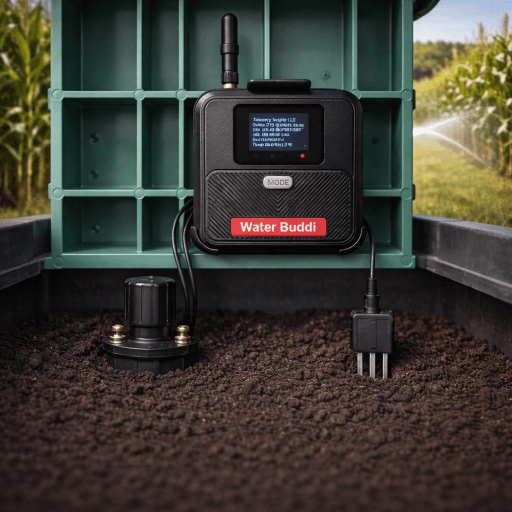
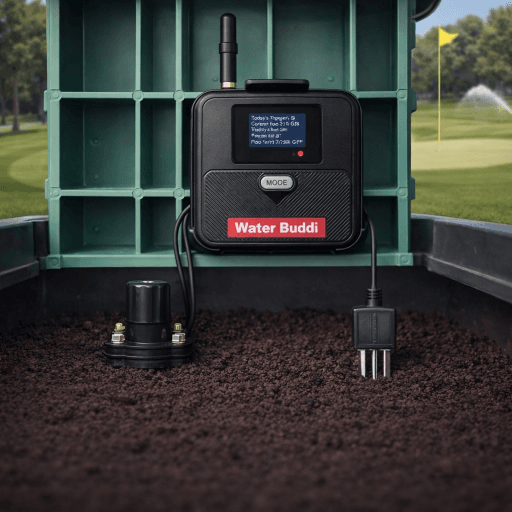
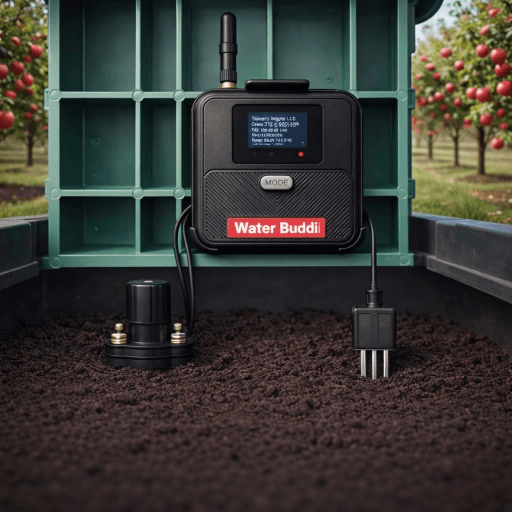
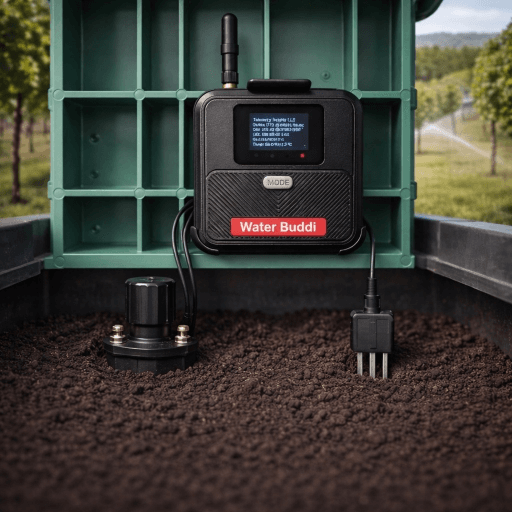
The Water Buddi Device
Every unit is identical hardware. The role it plays, WiFi, Node, or Hub, is determined automatically by signal availability, or manually via the app for Hub mode. All devices include full sensor and solenoid capabilities.
Hardware Specifications
- Dual radio: 2.4 GHz WiFi + long-range LoRa
- GPS (built-in, standard on all units)
- Onboard LCD display and control buttons, primarily used during installation and troubleshooting
- RS-485 Modbus soil moisture and temperature probe
- Sensor cable: default 6–10 ft; up to 20 ft available separately
- Onboard air temperature, humidity, and pressure sensor
- Internal battery backup, keeps device electronics running up to 24 hours (solenoid not powered on battery)
- OTA firmware updates with automatic rollback
- Includes USB cable and power pack for initial provisioning
Installation Guidelines
- Rugged, water-resistant enclosure, not rated for direct water exposure
- Recommended locations: irrigation valve box, inside a garage, or under building eaves
- Avoid direct exposure to rain, sprinkler spray, or standing water
- All devices must be initially provisioned to a 2.4 GHz WiFi network
- If WiFi SSID changes, device requires re-provisioning (data and settings are preserved)
- Primary customer interface is the app, the LCD is for install and field troubleshooting only
Built for Commercial Applications
Property Management
Centrally manage irrigation across multiple properties. Eliminate per-site manual adjustments and reduce water utility costs at scale.
Commercial Agriculture
Precision irrigation for row crops, orchards, and vineyards. Maximize yield while minimizing water and labor costs across large acreage.
Landscape Contractors
Offer smart irrigation as a managed service. Monitor all client properties from a single dashboard and document water savings for clients.
HOA & Common Areas
Consistent, automated care of community green spaces without manual scheduling or dedicated irrigation staff.
Golf & Sports Facilities
Zone-specific precision for greens, fairways, and fields. Maintain playing conditions while meeting water conservation mandates.
Municipalities & Government
Reduce operational costs and meet sustainability targets across parks, medians, and public green infrastructure.
Typical Commercial Install, Vineyard
A Hub/Node LoRa mesh covers an entire vineyard block from a single WiFi connection in the tasting room. Each device controls drip laterals and monitors soil moisture for its row. This diagram shows a typical Hub/Node role configuration, roles are assigned automatically and all units are the same hardware. Only Hub mode requires manual setup in the app.
Water Buddi by the Numbers
20-40%
Reduction in water usage vs. schedule-based systems
Up to 20 Devices
Per system with a 20-device subscription, scales to the largest commercial sites
~1 mile (1.6 km)+
LoRa wireless range, no trenching or WiFi infrastructure needed (terrain dependent)
Design Your Installation
Draw your field, mark exclusion areas, and run water and power lines. Get an instant bill of materials with real pricing, no account required.
Lawn & Turf
Residential & commercial lawns, parks, sports fields, golf courses
Garden & Landscape
Vegetables, ornamentals, raised beds, ground cover, perennials
Agriculture
Row crops, orchards, vineyards, berry farms, drip irrigation fields
Commercial
HOA commons, medians, green roofs, municipal parks, property management
Ready to Eliminate Scheduling and Save Water?
Tell us about your property. We'll design the right sensor configuration and connectivity approach for your site.
Need foundation protection? Check out our sister product.
Drip Defender, Foundation Protection Platform